
How can you explain something that’s not linear, something with an ending that loops back into its beginning, and with a beginning which already expects us to know the end? Anyone who’s ever had thoughts may have noticed how often this happens. These thoughts weave into a dense fabric of interrelated threads that give each other meaning – these threads may seem simple, but they are in fact spun from years of experience, knowledge, and the like.
In order to unravel this fabric of thoughts into text on the pages of this book, Sándor Révész decided to first turn them into spoken words. That’s where I – and my not-knowing – entered the story. I spent years learning how to know nothing with integrity – I have a philosophy degree to prove it –, and then more years in journalism figuring out how, if I did learn something, I could convey it to the world.
Of course, it’s not entirely true that I know nothing.

Beyond Access to Gravity being something of a continuation of Apeiron, it echoes with many quotes and passages lifted from its predecessor.
We worked on this book for more than a year – sometimes through regular joint conversations, sometimes separately, processing those conversations or shaping the written material. I was a bit of a reporter, experiencing and filtering as much as I could. I was a bit of an editor, chopping up paragraphs, relocating sentences across dozens of pages. I even became a bit of a researcher; it turned into a hermeneutic adventure – whether I wanted to or not, I ended up interpreting an emerging system.
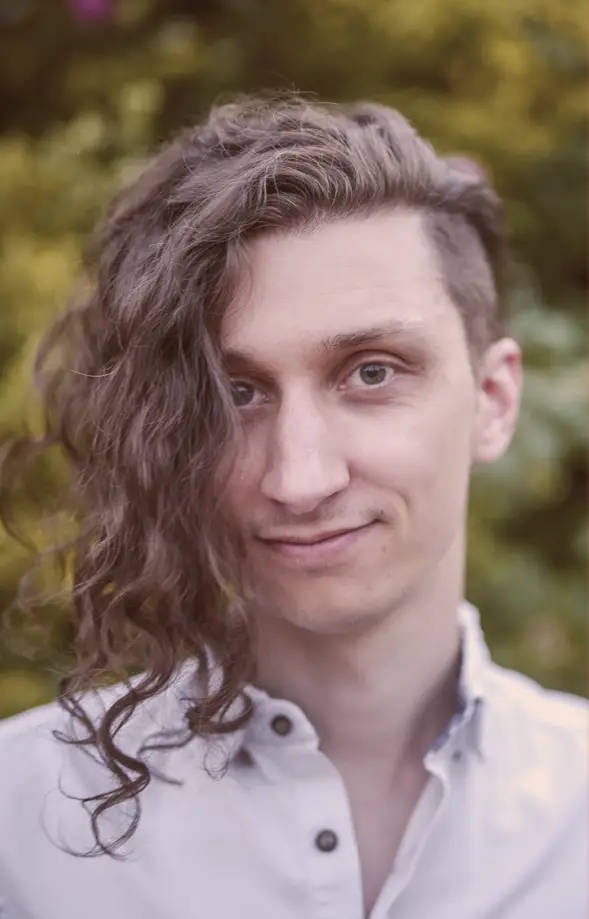
Márton Fogl
BUDAPEST, 2025. ÁPRILIS 24.
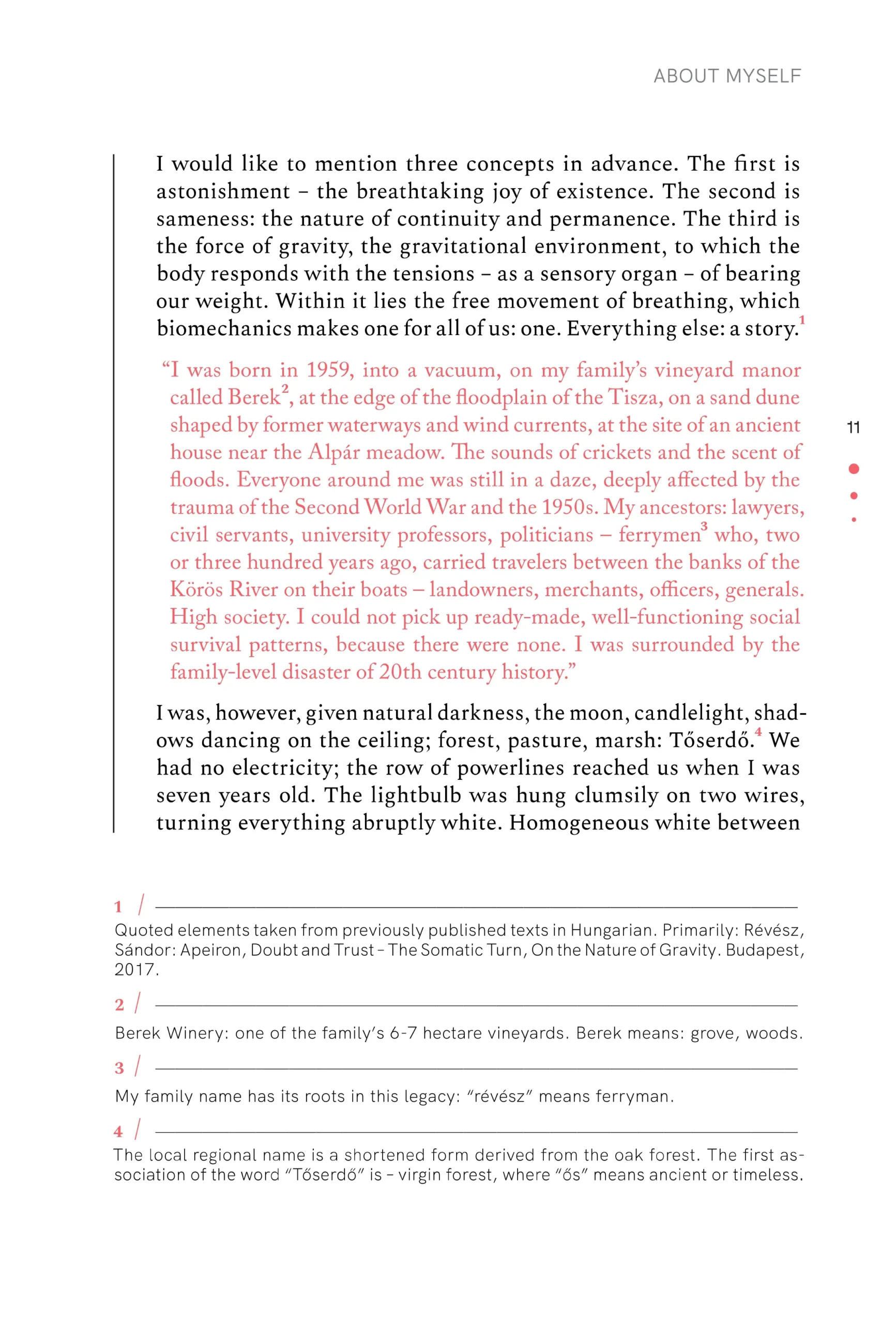
I learned about Contact Improvisation in Vienna in 1997 at a course run by Randy Warshaw, a former colleague of Steve Paxton. I danced as much as I could. Alone, experimenting. I tasted the unfiltered language, I engaged the duality within myself. The magic of the movements emerging in deep self-reflection filled everything, overrode everything. »Everything you feel and everything you think is your body and your soul.«
I learned about Dr. Ida Pauline Rolf’s biomechanical-based body therapy method on the internet. Two American-rooted, nearly contemporaneous methods, the Human Potential Movement approach, reached me in my thirties and forties: Contact Improvisation from New York, and Rolfing® from California. From the East and West coasts, two sides of the same coin: the experience of weight and balance, and its therapeutic application. I got Ida Rolf’s book, and was still nodding on the hundredth page. “Gravity is the therapist…”
This is how, more than twenty years ago, I became a Rolfer®. My message for today – as well as my endless gratitude towards three brilliant instructors: Randy Warshaw, Robert Schleip, and Hubert Godard – one who seeks nothing will find the same. The concept of body consciousness is false.
We must also insist that the patterns of our conceptual system, the intellectual frameworks unfolding in historical time, can be thematized and reflected upon; we must insist that we can “reach under them”, that we can talk about things that previously seemed inaccessible.
We must find our way back to our very humanity, and I am relating one of its – primarily bodily – aspects. Since the wholeness of our bodily being is – given. The tonic experience of tension-unity is accompanied by the emotional level of “everything is alright”, without the slightest need for intellectual support. Everything is alright, our body directly communicates it – through gravity. The body responds to gravitational force long before it can “know” anything, long before it can even “think”. Let us then try to grasp our bodily existence in its flesh-and-blood sensory organ reality, and as little as possible in some conceptual framework! This is what I attempted.
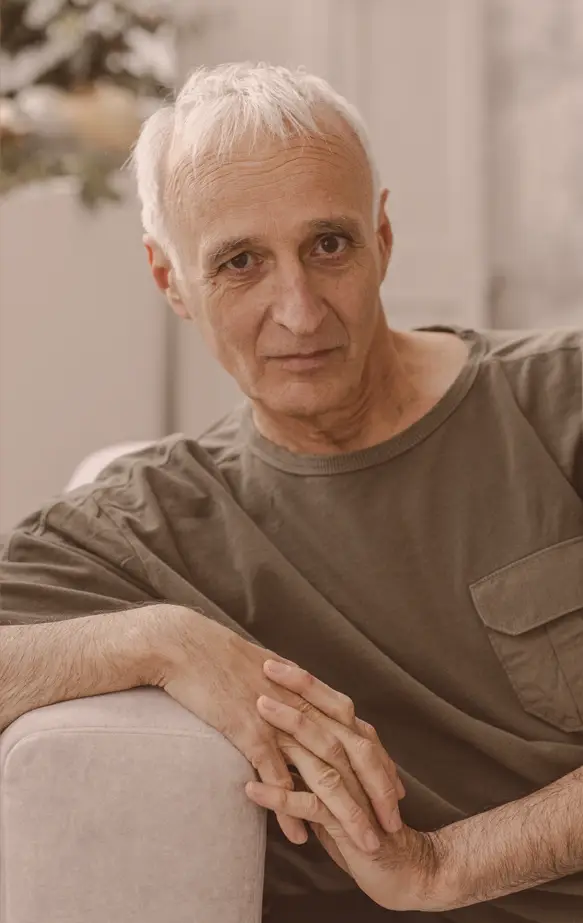
Sándor Révész
TŐSERDŐ, 2024. MÁJUS 13.
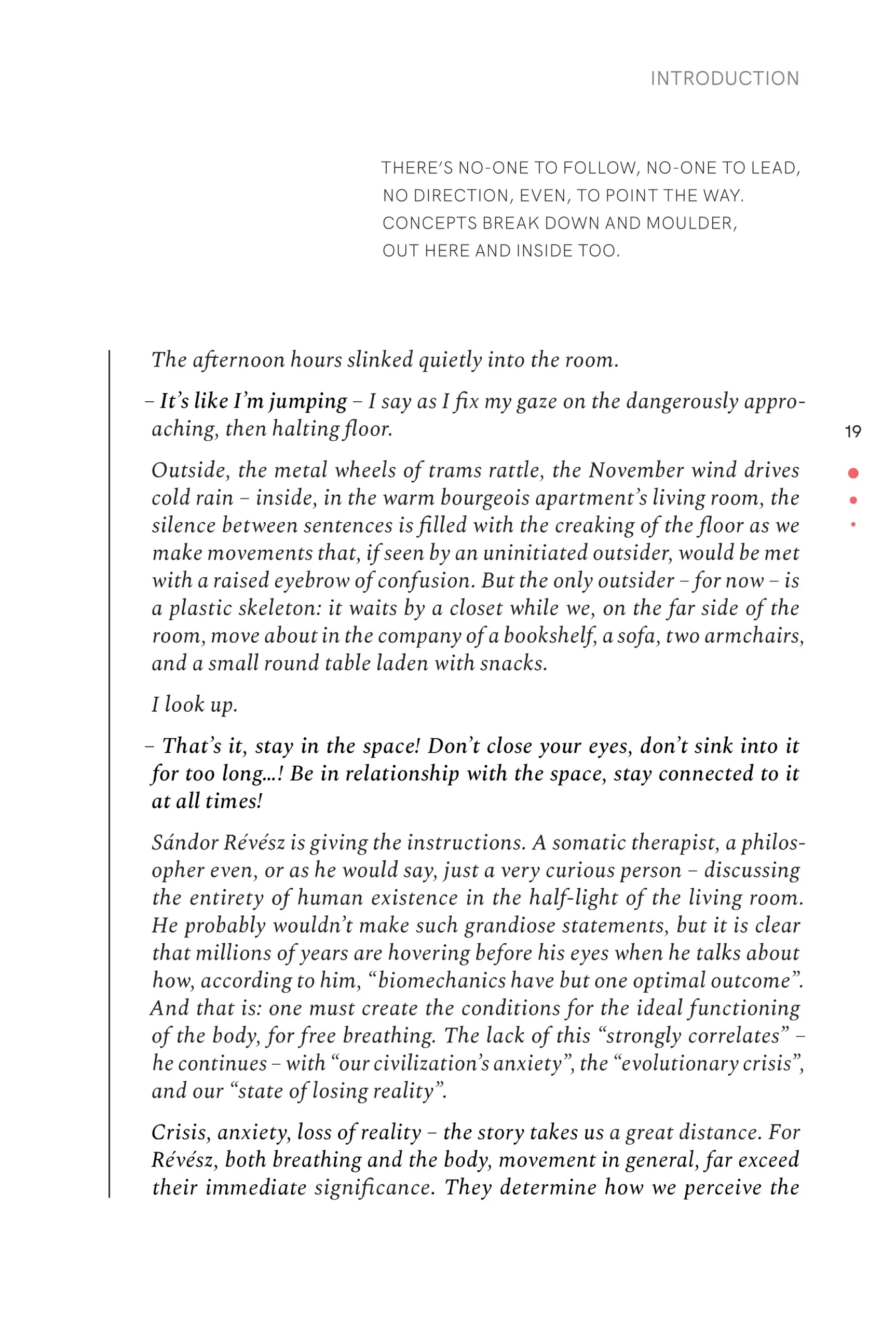
I don’t want to say anything new. In fact, what interests me is what has always been: the banality of “What’s up?” I am talking about myself, of course – beyond the bounds of the professional canon, and perhaps far too deep into my preferred turn of phrase – since I am my own experience, I am the one who can reflectively, with an analytical eye, look at the deep experience of that reality. Reflective experience: the deepest core of personality – a starting point and a return. The fundamental need of personality, an inescapable, necessary requirement, is the sameness-experience, the continuity itself, which often finds support in external pillars within the social relations of civilization.
The reflection of our bodily existence without question mark or need for explanation creates an excellent opportunity for the personality to rely on the strength of its own sources. »The pattern of behavior of merely observing myself is undoubtedly mine.«
What do I want to say, what would I like to talk about? That ability of ours which is worth its weight in gold: the sense of our own weight. How our movements align most closely with the banal laws of biomechanics.
I want to talk about how evolution has shaped us over millions of years into what we are in our bodies today. About movement, that movement coordination which is the hallmark and key to our becoming human.
I am not talking about what is good, what is bad, what is right, and what is not. I am talking, only and exclusively, about what is biomechanically optimal and what is less so. How we can get the best out of the evolutionary challenge of standing upright. Touching on its anthropological, psychological, sociological, and possibly philosophical aspects. The goal is the adaptation of this evolutionary challenge of uprightness to the civilizational environment – the opportunity and the chance. This is the task for specialists. To take possession, so to speak, of our own bodies.
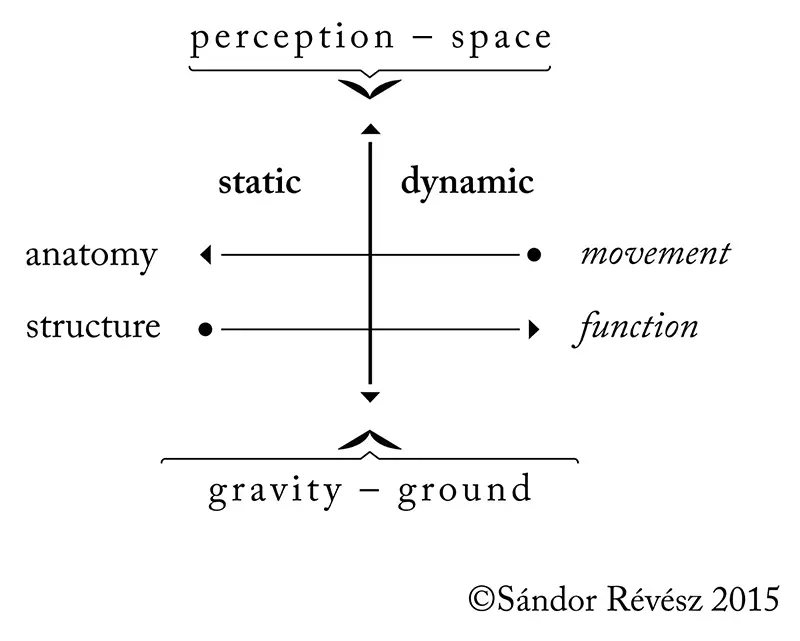
I have three exercises, and in their inexhaustible details, “everything” is contained. The first concerns our relationship with the ground, the second relates to our adaptation to verticality – upright body usage –, and the third is the biomechanically ideal experience of our spatial activity and movement’s basic pattern.
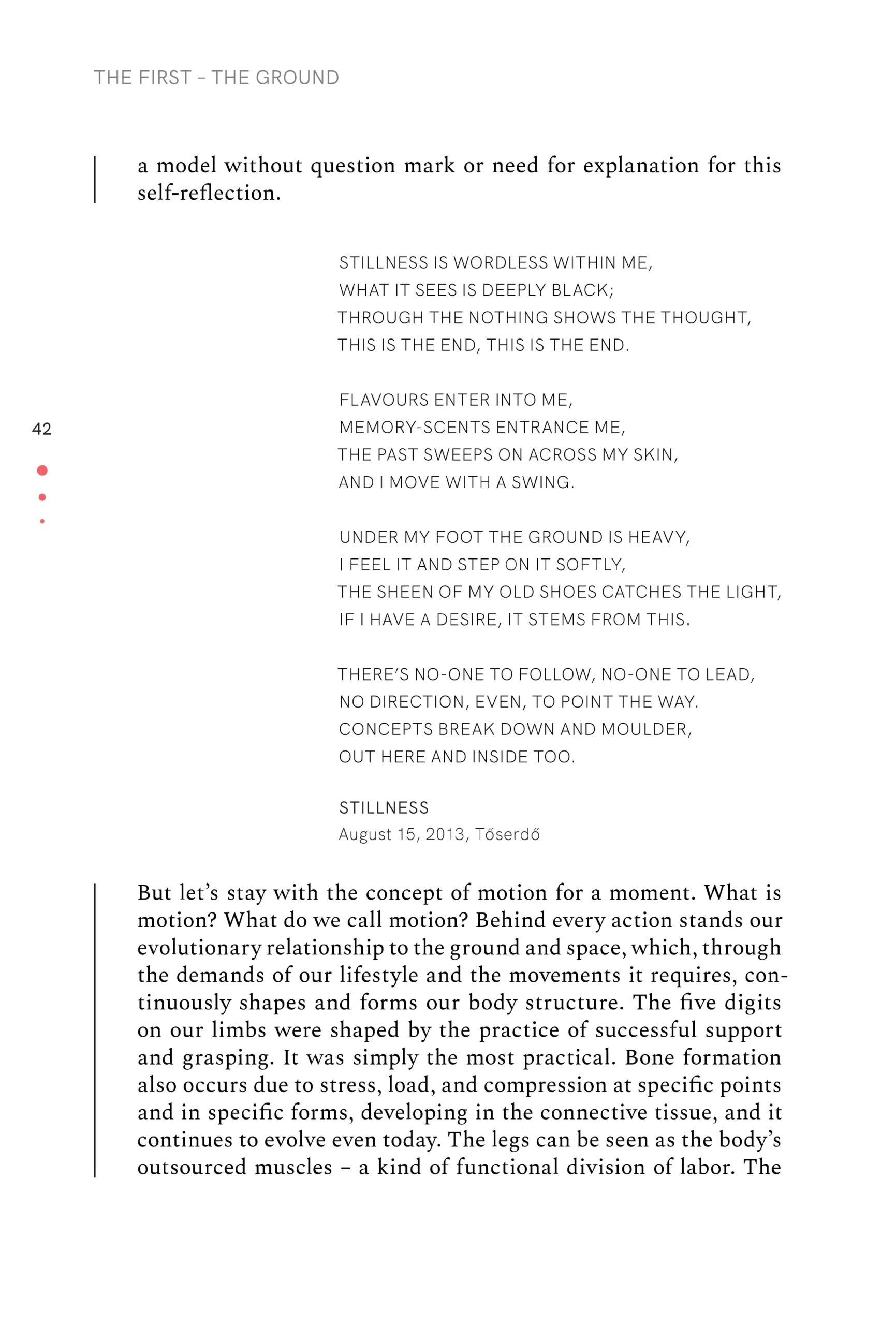
I originally designed this exercise to help the hip get into place. We stand, legs slightly spread, and drop our weight. As if a lift suddenly jolts downward, as if the ground beneath our feet opens up to a depth of twenty or thirty centimeters. Weight dropping, weight releasing, simply handing over the coordination: instead of voluntary movements, the body’s deep automatism, the reptilian brain takes over control. The hip moves back to where it belongs.
Until someone has intentionally tried to collapse, they might think it’s the simplest thing in the world. It’s not. Ever since I learned to walk, I’ve been working precisely on not collapsing, and more’s the pity: I’ve practiced it so much that now I can’t even start doing the opposite.
I call this “sensitive anatomy”. The sensitive, biomechanical experience of the structure, the anatomy of my body. The opportunity: to learn about the body through the effect of gravity.
The rain has eased off outside – we can hear the wind, which was previously chasing the clouds, now playing with the window frame. For a moment, the sky appears – a flat afternoon sunbeam runs across the walls, and we walk back to the small table among the dust particles swirling in its light. We sit around it as Révész continues; there’s still much to be said about the nervous system, self-awareness, everything. I pour myself a glass of water, opt for a grape over a savory scone, and listen. He continues calmly, comfortably, as if giving a lecture:
– These processes don’t even reach your brain…
The cerebellum is not accessible through consciousness. The cerebellum is the sensory organ of the present. By liberating or “emancipating” it – as 60-70% of the central nervous system’s neurons are located here – another source, another layer of our existence, of our being, becomes free, which – if it can be said this way – can emerge as a parallel shift in a different dimension, in the intellectual realm, which could be called a paradigm shift.
Act curiously regarding the emergence of the movement – Révész gives the instructions. Curiosity, that is the key for him; something is only worth pursuing with curiosity. – Attention – he continues – is only about finding the depth of the moment and being curious about what is happening there. To notice. But when you go there, you have no idea what will happen. If you did, there would be no reason to go there. Or, if you have an idea and you go there again and again to experience the same thing but remain unsatisfied, that could be addiction, dependency. While the joy of discovery, at times seemingly inexhaustible and unquenchable – that is passion.
There are three of us now: we visited the far side of the room, and the plastic skeleton rolled out from the corner when we arrived. Révész points here and there, explaining:
– …and when I let go of myself, I bring the tuberosity of my sitting bone into functional connection with the tuberosity of my heel. I can also do it if…
The anatomical model in front of me radiates the seriousness that demands silence in school science rooms. Yet, that required silence is mostly answered only with dubious rattles from the plastic skeletons – maybe for the first time, one of them is actually telling me something. Indeed – I realize to myself – the heel bone is directly under the sitting bone.
– I can also do it by jouncing on my heel. This is my second exercise. I jounce on my heel… It’s the experience of the vertical feeling, the lines of the vector system, the where and how. That’s it, shake, jolt, bounce on your heel! Both of them together, or alternately, right, left…!
In the first exercise, you let go of your body structure, surrendering your weight to gravity; in the second, you resist.
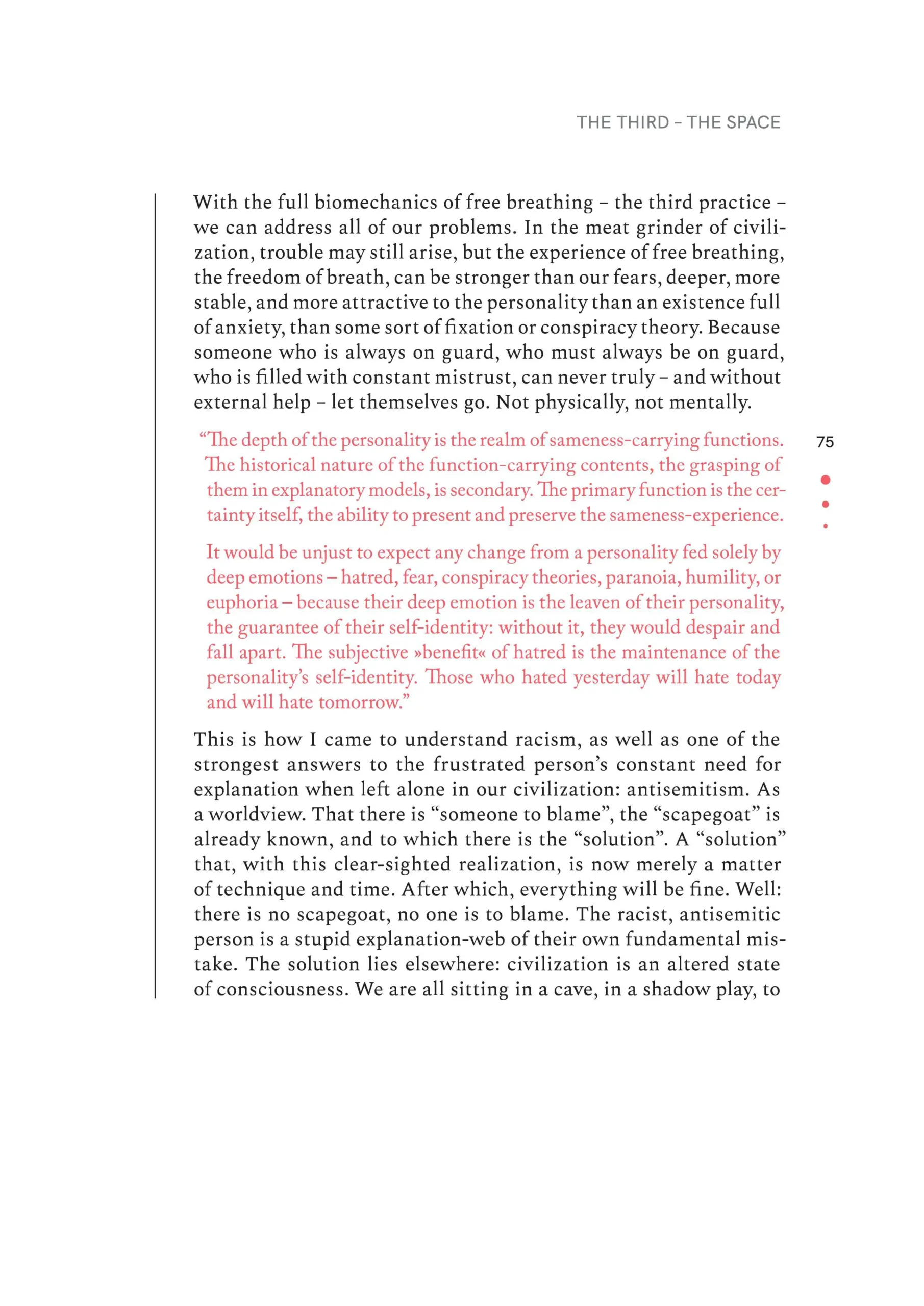
This is how I came to understand racism, as well as one of the strongest answers to the frustrated person’s constant need for explanation when left alone in our civilization: antisemitism. As a worldview. That there is “someone to blame”, the “scapegoat” is already known, and to which there is the “solution”. A “solution” that, with this clear-sighted realization, is now merely a matter of technique and time. After which, everything will be fine. Well: there is no scapegoat, no one is to blame. The racist, antisemitic person is a stupid explanation-web of their own fundamental mistake. The solution lies elsewhere: civilization is an altered state of consciousness.
– …and so we come to the third practice – continues Révész – the basic pattern of our use of space, the so-called contralateral rotation of the upper body, shoulder girdle, and hip in opposite directions, the spiral-swinging movement.
If a pigeon would peek through the window, it might see us mostly walking back and forth in the middle of the room, occasionally stopping, and then turning from the waist while standing. It may not fully understand, however, what Révész goes on to explain:
– The basic pattern of the third practice is this spiral movement. When you step… Yes, that’s it, yes, yes, right…
– This spinning-turning movement has a stretching, expanding, and straightening effect on the curvature of the spine – Révész continues to analyze the spiral movement, while turning to the intern movement of breathing.
The fourth dantian, the so-called “back dantian”, is traditionally associated with the Mingmen acupuncture point, which has received, and continues to receive, special attention in terms of health, movement, and martial arts, and is referred to as the Vitality Center, the Gate of Power, of Destiny, and Life. In my view, the chakra and dantian systems include the biomechanics of the balance response system to the spinal deformity caused by the forward tilt. That is, how we integrate the change in the body’s structure after the lordotic tilt. After all, it is the lordosis that caused the greatest, deepest evolutionary trauma to the spine, a trauma that can be addressed in bodily regression. Who hasn’t known the pain in their lower back?
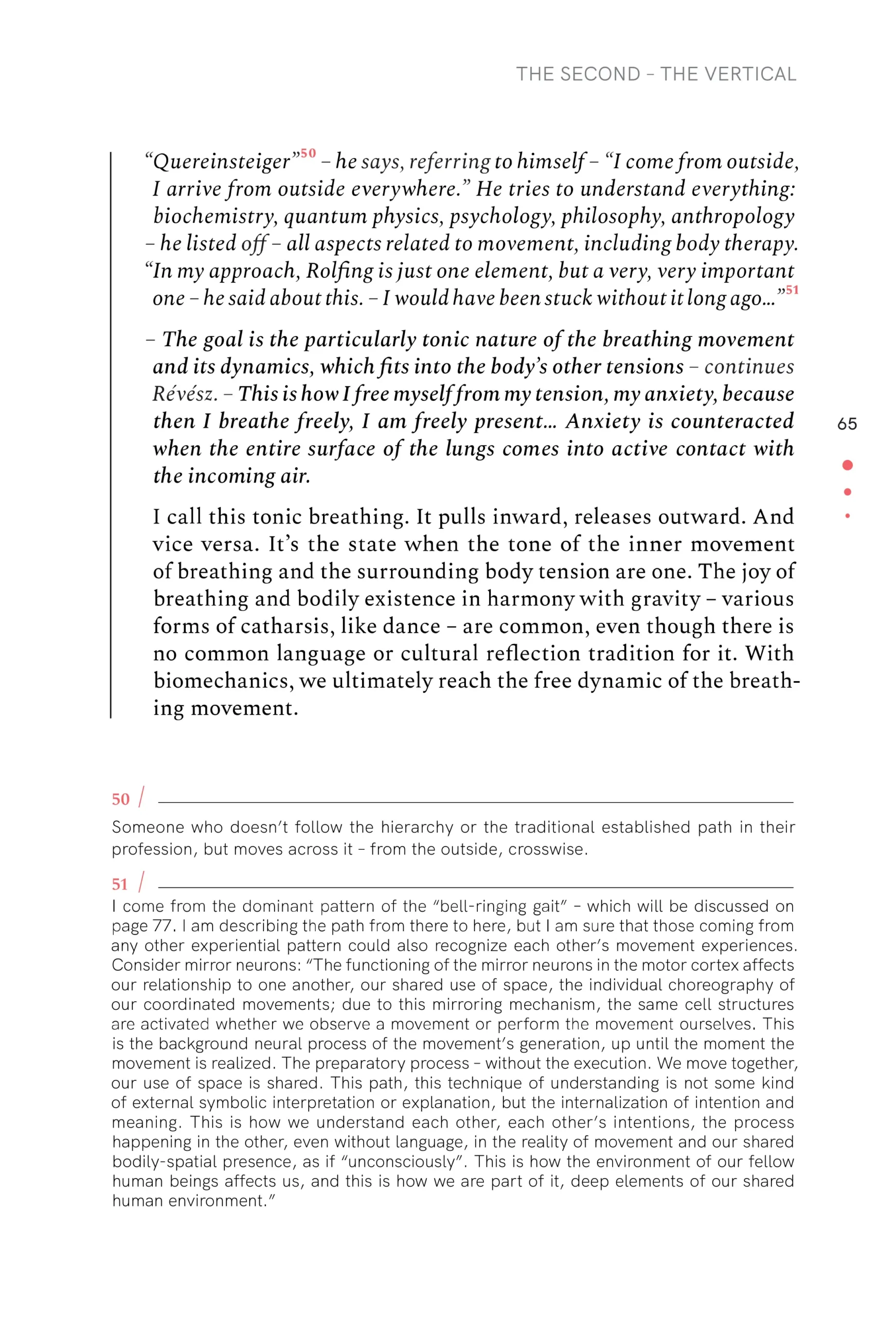
– A cardinal experience – says Révész about this whooshing.– Once the ground, the vertical, and the space are set – that is, once the previous exercises have been completed – all that remains is to unite “the external with the internal”. When you start listening carefully, eavesdropping, that is the moment you position your diaphragm in a state – there where you immediately stop your diaphragm – in which the tension environment is most suitable for it. Breathing-free attention. You neither tighten nor exhale, you just stop where it is most comfortable, instinctively, automatically. This is what I call tonic breathing: when the external and internal tension states unite in one tone. You stop your diaphragm, and…
… I’ve found that if I can get my diaphragm back to this biomechanically uniquely ideal tension state that allows the inner coordination of inspiration to make this free, dynamic movement at the back, then it impacts a person’s general wellbeing, it impacts a person’s civilizational anxiety.
– So long as you can’t truly breathe freely, biomechanically speaking – regardless of the reason, whether it’s something you’re aware of or something unknown – as long as this function isn’t ideal, it’s unlikely that you can be in a mental state without confusion and the need for explanation. And the reverse is also true: in a totalitarian, joyless, decaying society, where you’re a vulnerable subject, humiliated day after day, your posture and the internal breathing patterns of your body inevitably and imperceptibly change. We become anxious, and we slide back into the myth of strength, back into fascism.
So this is about the sincere and immediate experience of embodiment, of bodily being – the possibility of experiencing it – in which our relationship to gravity can be a pivotal point. And this is not realized in some formality, but rather through its depth and quality. In anyone, at any time. With any physical or mental characteristics.
In Révész’s system, the practices are signposts, keys, and doors to what lies beneath. And it is precisely that depth which interests me most: how we might progress from experiencing the material reality of our flesh-and-blood being in relation to the world, to the end of anxiety – and even to a complete social transformation.
And in fact, this is what follows from Révész’s thinking so far. This is a process that has a name: on the individual level, it is called “mental reflection surface reorganization”, and on the societal level, it is the “somatic turn”.
– This is what I believe, this is the position I hold: that one of the sources of our civilizational anxiety is the insufficiency, the inadequacy of our biomechanical adaptation – Révész sums up thoughtfully as I question him.– It’s not just about standing upright; it’s about our civilization as a whole. The alien, mass-based tradition of cohabitation, the alienated use of shared spaces. With our civilizational compulsions – such as forced and compulsive work processes – with the formal world of labor, we seem to be filling the void created by the absence of informal naturalness in our bodily co-being, the natural joy of existence free from question mark and the need for explanation. Yet we already have everything we need to make the world a pleasant place for us.
– And is that essentially the end of the story? Is that where our book will conclude?
– Almost. What I still think is very, very important is the distinction I make – the way I distinguish between evolutionary truth and the reality of civilization. Civilization is an altered state of consciousness…
On one side: hundreds of millions of years of evolution, embedded within us, of which we are the bearers and embodiments, right now. On the other side: the recent millennia, centuries, the more recent virtual decades of our history – our radically, fundamentally, and irreversibly transformed environment – which has triggered equally radical changes in our adaptive responses, our attempts at adaptation, our mental background processes. The result of these profound changes is what we’ve already referred to several times as the altered state. We run our lives along countless threads of macro-programs in an attempt to escape the pressure of constant, permanent need for explanation, to avoid getting stuck at every moment asking, “What’s going on?” This capacity is both an evolutionary advantage and a reality-losing disadvantage.
We live in attempts at survival and adaptation – sometimes unsuccessful ones. We are faced with challenges that are unknown to us, and for which our evolutionary past has only partially prepared us, or perhaps not at all.
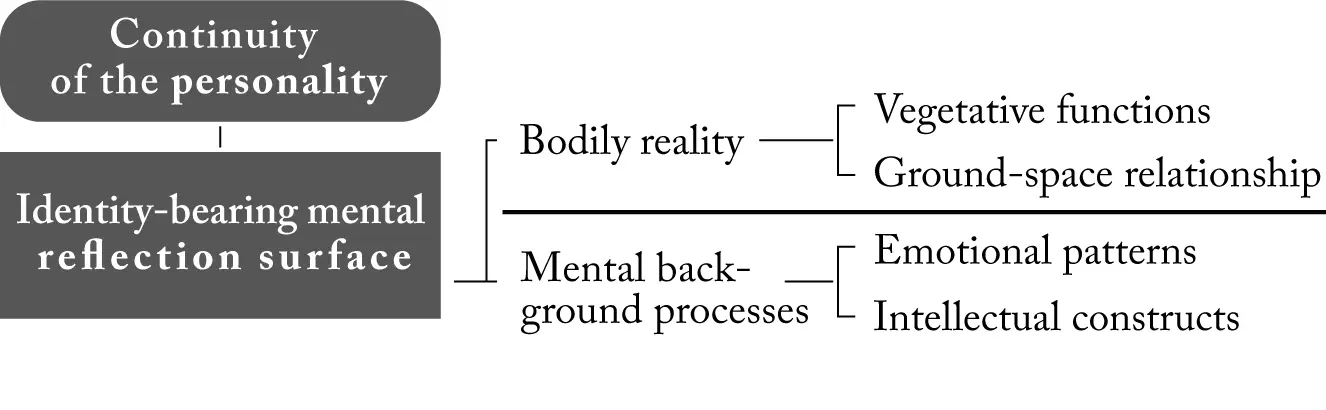
Sameness is an issue neither material, nor formal, nor content-based, nor interpretative – it is functional.
– If this is the active experience of our personality – continues Révész – then we can let go of clinging to various opinions, memes, political templates, mental-emotional package deals, and getting stuck in this or that pattern. Like, I don’t know, identifying myself solely by the function I fulfill in society. Because, let’s say I’m a teacher. I define myself as the one who carries that social behavior pattern, function, role. Or I’m a politician and have power, or I’m a businessman and have a lot of money. Or that I’m Hungarian… So there are many kinds of continuities, coexisting and running parallel… Or I’m totally off the rails and I’m racist, antisemitic… What is common behind all of this: the irreplaceable necessity of the experience of continuity and sameness – and the fulfillment of that need.
As I listen to Révész, a vision of a better world begins to emerge. I try to imagine the somatic turn he outlines actually taking place. Here, in this calm room, in peaceful conversation, it all seems quite real. Seeing Révész’s consistently liberated, easygoing presence, it’s hard to think anything other than – the recipe works.
He continues:
– I think it’s very important – and I’d like to emphasize once more – that in this deep evolutionary crisis we’re living through, we must respond with a truly profound evolutionary answer. And this might be it: the experience of our bodily structure is a very deep, reptilian automatism. It is hundreds of millions of years old, and you can’t do anything with it but experience it – but that, you can do. Because, as I’ve repeated many times, the body is a sensory organ specialized in tension.
A nearly four hundred million-year-old automatic sphere of competence – we’re nearing the end of our conversation with these familiar thoughts. – And here we are, at a point where, in this virtualized world, we lose our last connection to reality. That we would live our postmodern human-being “beyond facts” – post-truth. And if we don’t know, if we couldn’t know what reality is, then this is it. Our nervous system’s deep automatism gives us news from the deepest level of our reality.
I believe that on the other side, where Révesz sits – as opposed to the anxious person – we meet the dancer. As he guided me through the exercises, we kept approaching this point, as if free movement itself were the dance. He smiles as he notices the inner dance even in moments when, during my exploration of gravity, I almost lose my balance. “Incorporate the elements of the first and second exercises into the turn”, he remarked. “The dropping, lifting, and alternating heel bounces. It will instantly become a dance.”
What do I consider important? This: to say that our bodily being is the very experience of evolution, and not some sort of civilizational problem that we must reject, push away, or approach with all kinds of expectations, seeking some sort of solution. This is the most important thing I can say to the next generation. The state of our relationship with the body – a state without question mark or need for explanation – is the deepest reality of our existence, and through reflection on the very evolutionary traits and characters of our bodily being, it is available to everyone, at every moment. This is it, and there is nothing more.